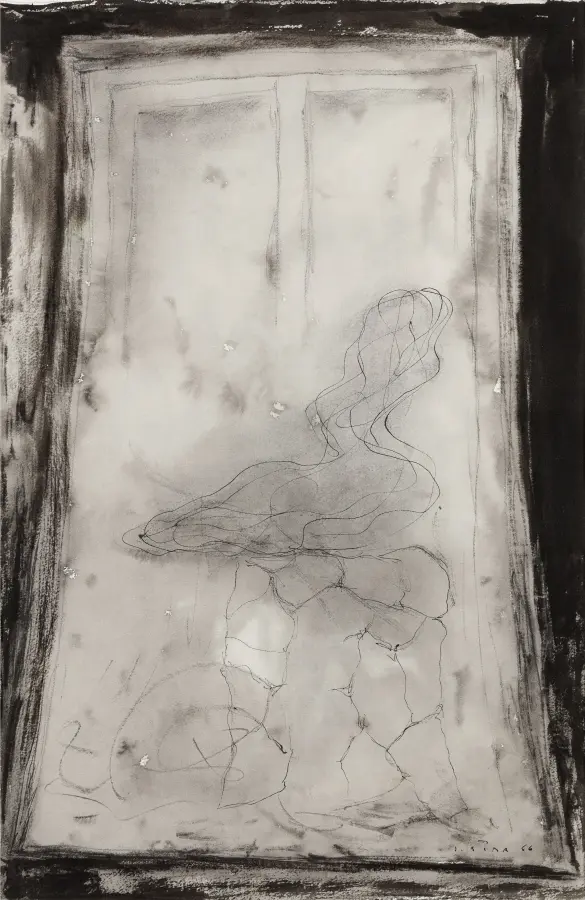
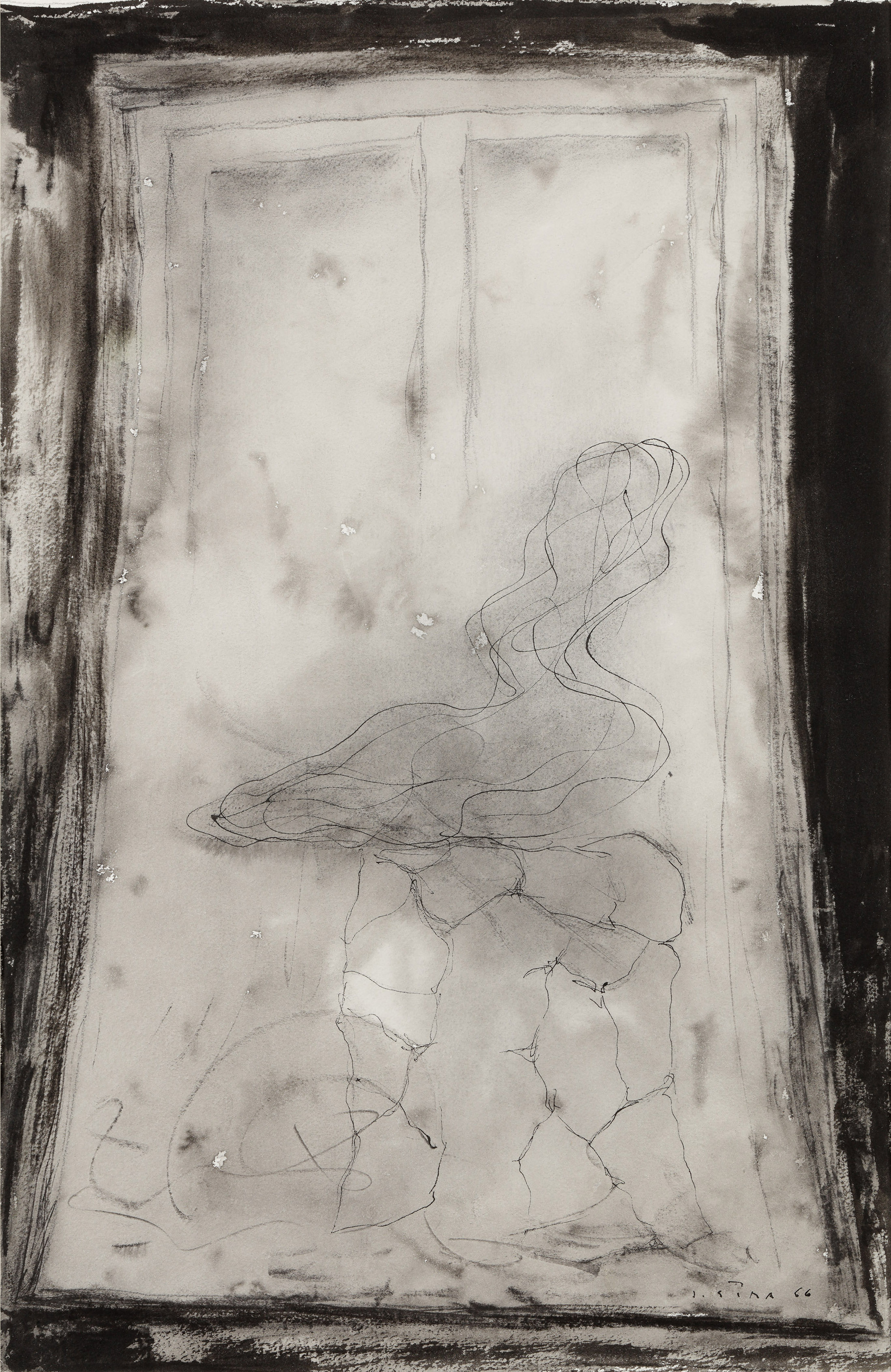
Lot 52. Orpheus’s Gate
watercolour and ink on paper
cutout of passe-partout: 54 x 35 cm
signed and dated lower right: J. Sima 66
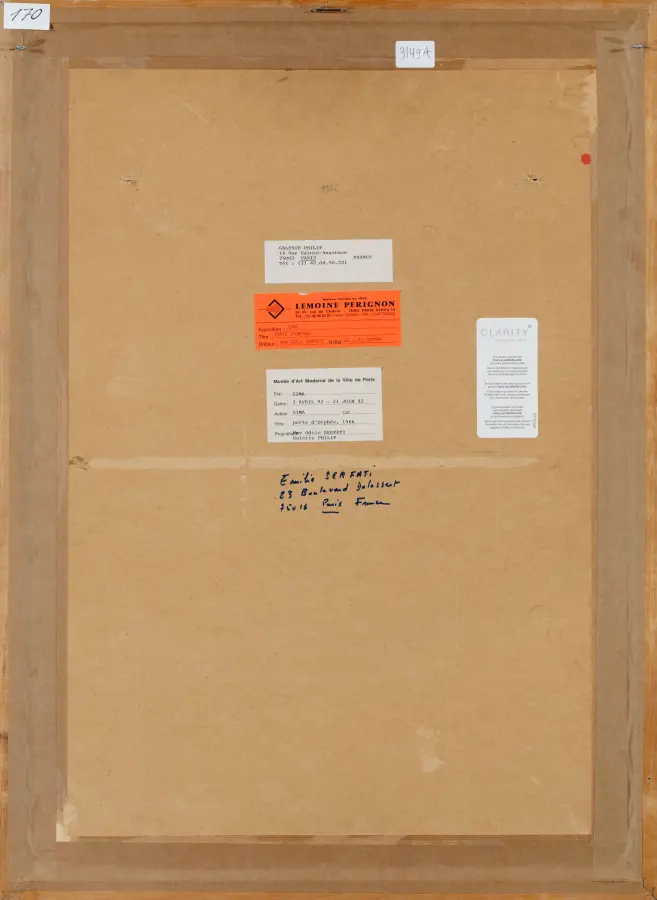
verso old exhibition labels Philip Gallery and Musée d’Art Moderne de la Ville de Paris
Exhibited:
– Sima, Oeuvres sur papier 1922 –1971, Philip Gallery, Paris, 1988
– Sima, Musée d’Art Moderne de la Ville de Paris, April 3 – June 21, 1992
Publicated:
– Sima, Oeuvres sur papier 1922 –1971,published by Philip Gallery in Paris in 1988, reproduced under no. 31
– Sima, published by Musée d’Art Moderne de la Ville de Paris in 1992, reproduced under no. 178
Expertise by Dr Karel Srp, dated 3 June 2020, enclosed. Dr Srp remarked: “This drawing relates to the myth of the transition between worlds, a theme Sima explored in the paintings and drawings he dedicated to Orpheus from the late 1950s and early 1960s, in which he once again returned strongly to the expression of transcendental light. In contrast to his earlier, meditative works, he conceived this drawing as a drama, suggested by its internal dynamics unfolding across several levels of expression. The very shape of the gate is striking, transforming from a rectangle into a widening trapezoid in its lower third. It looks like a separate object, anchored nowhere, suspended in the darkness that surrounds it. It has become the sole passageway, offering a glimpse into places normally inaccessible to mortals. Sima explored the very transition between the worlds of life and death, a point that was fundamental to him, as it signified a shift from empirical vision to a supernatural vision. Passing through Orpheus’s Gate allowed one to enter the realm of shadows. This process is depicted by two states of matter, rendered in ink: the lower one, suggested by stones representing the earth, and the upper one, resembling a flame in its formlessness; yet in both cases, the viewer already finds themselves in the realm of dematerialized shadow, into which Sima has cast them through his drawing. In this exceptional work, the artist presents a comprehensive vision. It ranks among his most important works from the second half of the 1960s. The extent to which Sima managed to pass through this very gateway, set for himself, is indicated by his final works from the early 1970s.”
Furhter consulted with Dr Irena Zantovska Murray HonFRIBA, Professor Jaromir Zemina, Dr Jiri Machalicky and Vladimir Lekes.